
Perimenopausal Cognitive Changes: "the female brain doesn't decline, it adapts"
Notes from my favourite lecture during the recent World Congress on Menopause in Melbourne, by none other than Prof Pauline Maki.

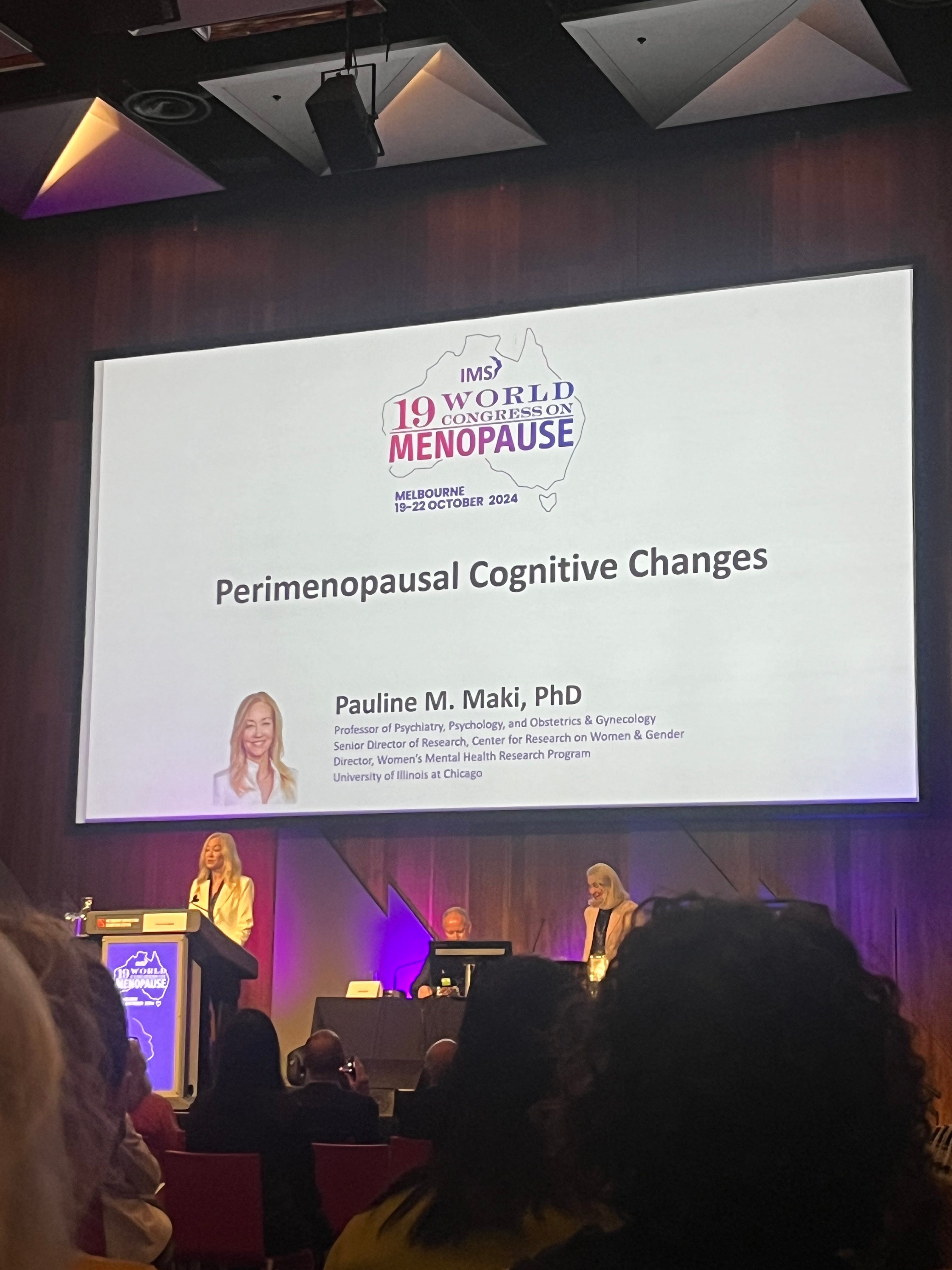
Perimenopause is a window of vulnerability for women, especially when it comes to cognition.
Two cognitive abilities are affected:
Encoding (this lecture)
Ability to recall (this lecture) later
The very act of handing out an information leaflet on brain fog to someone — normalizes it.
—P. Maki
*Recommended read: Brain fog in menopause: a health-care professional’s guide for decision-making and counseling on cognition
Verbal Learning & Verbal Memory
There’s very strong evidence of decline in verbal learning & verbal memory and it begins in the perimenopause. Most evident are the learning and recall of words, stories.
Do these cognitive changes resolve in the postmenopause? Do women bounce back?
SWAN (n=1985) found rebounds in verbal learning & verbal memory.
WIHS (n=443) found that they do not rebound.
POAS (n=403) found rebound in verbal memory but not verbal learning.
Conclusion is, we don’t know (no strong evidence). We do know that some women rebound, while others don’t.
Cognitive performance is maintained in the normal range for most women though about 10% of women experience a clinically significant change that persist into the postmenopause. —Maki PM et al., 2021
How about brain function in perimenopause/menopause? We don’t know.
This is a critical gap: There are no longitudinal neuroimaging studies examining which aspects of brain health change as women transition from the pre- to peri- to postmenopause.
The problem with data that we have now is the possible over-generalisation of data on people with risk of Alzheimer’s
‘Whole Brain Connectomics’
Brain efficiency measured by differences in global brain networks is lower in the perimenopause group compared to the premenopause group.
Cognitive impairment during perimenopause probably has a lot to do with connectivity (or lack of it) of these brain networks.
The female brain doesn’t decline, it adapts.
The postmenopausal brain shows a decrease in hippocampal activation which is related to worse memory performance. The left hippocampus is more active in encoding verbal memory. (In younger women, left hippocampus > right). It recruits the contralateral hemisphere with age, which requires estradiol connectivity between the left and right hippocampus.
Vasomotor Symptoms and Cognition
Cognitive difficulties in the perimenopause commonly co-occur with VMS, sleep difficulties and low mood.
VMS are experienced on average of 7.4 years (!!!)
Hot flushes are associated with declines in memory & adverse effects in the brain:
decreased verbal memory
Alzheimer’s Disease biomarkers
altered activity in brain circuits as women learn words
white matter lesions
decreased hippocampal functional connectivity
Hot flushes improve —> memory improves. (this is based on a study on stellate ganglion blockade)
It is hypothesized that treatments that effectively improve VMS, sleep and/or mood may benefit cognition. However, clinical trials in peri- and postmenopausal women are lacking.
Estrogen does not improve cognition/brain function, but treating menopausal symptoms with estrogen might improve it.
How about men?
Men at midlife experience cognitive impairment to a certain extent, but not the same magnitude as perimenopausal women.
Is brain fog = memory?
Women often may use one umbrella term to describe — distractibility, forgetting why she walked into a room, and problems with memory.
Again, the hypothesis is that it all occurs at the network level of the brain.
Does menopausal hormone therapy help with cognition?
Evidence showed that the higher the level of endogenous estrogen, the better the connectivity in the brain networks. But there are no trials on exogenous estrogen.
What about ADHD & neurodivergent symptoms that emerge during the perimenopause?
There are a number of women who experience this — ADHD appearing like symptoms in the menopause. But there are no RCTs on this.
Does mindfulness & meditation help with memory?
Meditation, yoga, stress reducing techniques etc. — helps with menopausal symptoms, but unfortunately memory isn’t one of them.
But, for example, if mood impinges on memory — then, yes.
Executive function (e.g. strategic thinking, planning) declines with age, but not due to menopause. But WISDOM increases, yes. That’s called ‘crystallization of intelligence’ :)
*Read on crystallized intelligence here.